The team that is Leigh Phillips, William Stromberg, Intrada Records and the Royal Scottish National Orchestra have done it again! This time with a new Kickstarter-funded recording of Jerry Goldsmith’s score for the 1969 thriller “The Chairman” (AKA “The Most Dangerous Man in The World”). The film starred Gregory Peck, was mostly made in the United Kingdom and directed by British director J. Lee Thompson.
Goldsmith’s music is one of several projects of his that had far-eastern settings. He was a tremendous composer for percussion and one who really liked to experiment. Even to the point of using dried rice on a bass drum on the opening title cue. The reasons for this new recording are that the original master tapes no longer exist and that the original album is incomplete and only on vinyl (not including digital rips).
In July of this year, a few weeks before the recording sessions took place, I met up with score reconstructor and producer Leigh Phillips in Prague. He was able to give me an insight into the unique instrumentation of “The Chairman” score. He said that on receiving the original charts, orchestrated by Gary Hughes, there was not much specific information about percussion, despite requiring a lot of it. That was when Leigh’s incredible listening skills came in, ensuring that the reconstruction and interpretation honoured the film's original soundtrack.
(Leigh Phillips [left] with me in Prague, July 2025.)
The recording has been lovingly made with painstaking care. With the exception of two minor overdubbed parts, all of the players are together in the same space at the Royal Concert Hall in Glasgow.
With the “Main Title” music the listener is immediately immersed in a Chinese-influenced soundscape through the extensive and experimental use of percussion, as well as cimbalom, banjo and mandolin. In addition to sounding Chinese, I believe that the cimbalom adds an element of Cold War paranoia throughout the score - remember "The Ipcress File"? Probably my favourite of all the cues is “The Russians Are Coming",heard at the climax of the film.Itsvirtuoso use of the Almglocken (tuned cowbells) is like nothing else and pure Goldsmith.
“The World Only Lovers See” (love theme) features a wonderfully simple and romantic piano solo. Originally Jerry Goldsmith himself played the solo on the original album, however on this occasion it was performed by the pianist of the RSNO, Lynda Cochrane. Maestro Stromberg later remarked that her playing was, in his view, better than that of Goldsmith.
In addition to "The Chairman" score, the team were able to record some bonus cues from other films, thanks to extra money raised as part of the crowdfunding. These included the end credit music from “Rambo II” and a cue called “Alex’s Death” from “Under Fire”. The penultimate track on the album is a grand and majestic piece, “The Flag” from “Not Without My Daughter”.
The final track, is a new realisation from Leigh Phillips of an unused piece. It was composed by Goldsmith for “The Game of Their Lives”, shortly before his death in 2004. I’m sure Goldsmith would have been proud of Leigh’s arrangement.Leigh has even produced a video on how he did it.
Once again, the Intrada team have achieved immaculate results that all music lovers really ought to hear and they have already announced their next Kickstarter recording project, which is going to be "The Night of The Hunter”. Music by Walter Schumann.
A very Merry Christmas and a very Happy New Year to everyone!!!
Once again, legendary British conductor John Wilson has been on tour presenting some of the greatest hits of Hollywood, with renowned singers Kim Criswell, Matt Ford and Jamie Parker. The orchestra was Wilson’s own Sinfonia of London re-established by him in 2018.
The concert at Manchester’s Bridgewater Hall, opened with the MGM Jubilee Overture which was arranged in 1954 by the studio’s musical director, Johnny Green. This instrumental medley features numerous MGM numbers such as Singin’ in the Rain, I’ve Got You Under My Skin, Over the Rainbow and The Trolley Song. Having heard the original recording of it as well as John Wilson's recording, Wilson conducted a little bit faster in places on this occasion. In my opinion this does not ruin the piece. On the contrary I think it helps to drive it along and works remarkably well in concert.
Kim Criswell and Matt Ford flawlessly delivered Cole Porter’s Stereophonic Sound from 1957’s Silk Stockings. Having recently sung this song with a friend at Dartington summer school, back in August, I can confirm that it is not the easiest song to perform. Matt Ford then left the stage and Kim Criswell then gave us a haunting and very emotional solo performance of Secret Love, that was originally performed by Doris Day in Calamity Jane. The Heather on the Hill from Brigadoon is a great example, not only of fine music and lyrics going together, but also of great arranging. The song was written for the film by Lerner and Lowe and was arranged by Conrad Salinger. Actor and singer, Jamie Parker performed the vocal refrain. His performance was nice and gentle, this contrasted with the ballet music that Salinger had arranged.
Another instrumental piece, was the overture from High Society, arranged from Cole Porter’s songs for the film by Conrad Salinger and Lloyd ‘Skip’ Martin. John Wilson conducted lightly and with finesse and the orchestra gave the music the articulation and colour that it needed. For me the highlight of the first half, was Matt Ford's performance of Pure Imagination, from Willy Wonka and the Chocolate Factory, in its original arrangement by Walter Scharf. As a fan of the film and its music I was paying particular attention to this performance, and I think it was electrifying.
Kim Criswell concluded the first half with I Got Rhythm from Girl Crazy. During the instrumental part, the audience applauded different sections of the orchestra as if they were jazz players, even the violins and violas, who stood up and gave us a spine-tingling virtuoso performance.
The second half began with the main title music from Singin’ in the Rain, this involved all three vocalists, who sang the first verse of the title song whilst walking across the stage. It was immediately followed by Good Morning. Both pieces were perfect representatives of such a film.
One rarity that was played, was the Jerry Herman ballad Love is Only Love written for the film version of Hello Dolly! and was originally performed by the star of the film, Barbra Streisand. Kim Criswell has an extraordinary ability to channel the great leading ladies of Hollywood and Broadway, including Streisand. Another glorious rarity was the original Irwin Kostal arrangement of Jolly Holiday from Mary Poppins, complete with members of the orchestra playing kazoos during the Penguin dance sequence.
Matt Ford gave a wonderful and moving performance of If ever I would leave you from Camelot and I think John Wilson was right to call it one of Frederick Lowe’s finest ballads. Jamie Parker’s rendition of I’ve Grown Accustomed to Her Face from My Fair Lady, may not have been an imitation of Rex Harrison, but he certainly was able to channel him. Learning all those words for such dramatic number must have been a huge challenge.
The penultimate piece of the evening was the unofficial Hollywood anthem That's Entertainment from 1953’s The Band Wagon. I could not help mouthing along to this number, knowing every word of it. The encore which brought the evening and the tour to an end was There's No Business Like Show Business, originally from Annie Get Your Gun. I am unfamiliar with the arrangement that was performed. But Kim, Matt and Jamie did splendidly with Kim taking the lead with here spot on Ethel Merman imitation.
I believe that this was a glorious performance as well as a wonderful end to a national tour. I sincerely hope that John Wilson and the team embark on another one next year. Also, I wonder if there’s any chance in the future of such a show returning to the proms.
In this episode, I speak to Swedish composer and silent film accompanist Matti Bye, about the scores that he has written for both silent and contemporary films. The interview was recorded in June, at the 2023 Il Cinema Ritrovato festival in Bologna, Italy.
In recent years, Intrada Records have used Kickstarter to fund their re-recording projects. This year, they have teamed up again with composer/conductor William Stromberg who, in the 1990s, pioneered re-recording classic film scores from start to finish. The goal of this Kickstarter project was to record two Bernard Herrmann scores, ‘On Dangerous Ground’ and ‘The Man Who Knew Too Much’. For both scores, it is the first time since the 1950s that they have been recorded in their entirety, so I am lucky to be one of only a handful of people who have heard them played live since that time.
On the first day of recording, the team started with the Prelude from ‘On Dangerous Ground’. I had only heard this piece a couple of days before. I was more familiar with ‘The Death Hunt,’ which is a piece from the film that a lot of people know of because of numerous performances and recordings. ‘The Death Hunt’ is written in a typical Bernard Herrmann style with lots of repetitive rhythms played by a huge orchestra.
The first run-though of the Prelude blew us all away! And it gave us some idea of the standard of the Royal Scottish National Orchestra (RSNO). The first run-through was not recorded, it was just used to acquaint the orchestra with the music. However, it was obvious that they knew the piece very well. By the time we started recording, it was as if they’d been playing it for years.
(Bill Stromberg talking with Doug Fake and Mike Ross-Trevor.)
Cues were be recorded in full, and sometimes they would be recorded again in sections so that they could be edited together, if necessary, by Mike Ross-Trevor, who oversaw recording. Anna Stromberg, An orchestrator and Bill's wife, and I were sitting behind Bill, and we had the scores in front of us, as well as a crib sheet with approximate timings as to how long each cue should last. Although Bill wasn't conducting ‘to picture’, he wanted to try and be as close to the original film tempos as possible to be faithful to what Herrmann would have wanted. When it comes to Hermann’s original conception of the music, the Prelude contained a section that was cut from the original soundtrack recording; this coda was re-inserted in this new recording. I think this will be the first time anyone will have heard that section, and you will hear it on this new album.
There were many people who had input into the recordings, not only Doug Fake in the control room, but also Anna and Bill’s colleague and friend John Morgan who was watching the livestream and was texting Anna with suggestions. I presume he also had the score in front of him. With the Prelude, I suggested to Bill that maybe the run-through was a little bit too fast because Hermann, as a conductor, was notorious for conducting slowly, at almost half the tempo the pieces were written. Bill agreed and conducted it at a little slower. Afterwards, Doug Fake came through on the intercom and said that it was perfect.
After lunch we started on ‘The Man Who Knew Too Much’. For this score, we recorded all of Herrmann’s original music for the film, plus the VistaVision title music written by Nathan Van Cleave. This piece requires lots of brass and percussion; 6 trumpets, 6 trombones, 2 tubas, 9 horns, and 9 percussion players. Tam Tam and crash cymbals were used because they are an integral part of the story. This brilliant fanfare blew everyone away! It's not often that you hear very short pieces of music played at full blast by a live orchestra because they are just meant to be heard on film soundtracks. We recorded both versions of the opening title music, but only one was used in the film.
Spoiler alert, for those who aren't familiar with ‘The Man Who Knew Too Much’ there is the famous concert scene filmed in the Albert Hall in which the composer, Bernard Herrmann, has a cameo. He was conducting the London Symphony Orchestra performing a piece that wasn't recorded for this album because wasn’t by him. This piece was written by Arthur Benjamin and called ‘Storm Clouds Cantata’ composed for the original film in the 1930s. The scene depicts an assassination attempt on the prime minister of a fictional country who is attending the concert. The music is part of the plot there is a crescendo, when the cymbals crash together, meant to mask the sound of the assassin’s gun going off.
On the second day of recording, we had a smaller orchestra, and this is when we recorded the viola d’amore solos from ‘On Dangerous Ground’. For those of you who don't know what that a viola d’amore is, it’s an early Baroque string instrument. Herrmann wrote several solos for the film for this instrument with, orchestral accompaniment. We also recorded some small pieced from ‘The Man Who Knew Too Much’, such as the three, so called, ‘Arab Trios’ using only three players: a harpist, a violinist, and a clarinettist. The ‘Arab Trios’ are source music that was played in the background during the sequences in Marrakesh. These were the last pieces that were recorded.
It was great sitting with Anna, behind Bill; you could say it was like being at one of the best concerts ever! Yes, it was a recording session where you're not allowed to clap and you expect the orchestra to make mistakes and keep stopping and starting, but it was a wonderful experience. It's not every day that you hear these full scores performed from start to finish. For highlights of these recording sessions see the Kickstarter page.
Acknowledgements:
Thank you to Bill Stromberg who was kind enough to obtain a pass for me. Thank you to Anna Stromberg, Paul Talkington, the Intrada team, and people at the studio for their kind hospitality. And a huge “well done” to the RSNO!!!
Last Thursday, whilst on a trip to Stockholm, I attended a concert of film music performed by Broadway singer Kim Criswell and The Royal Stockholm Philharmonic. It was conducted by the champion of film and theatre music, John Wilson.
The concert opened with Erich Wolfgang Korngold’s title music from ‘King’s Row’. John Wilson paraphrased Andre Previn saying that people have often said that Korngold sounds like Hollywood, but in fact it was the reverse, Hollywood sounded like Korngold. The main title music from the film provided us a stirring fanfare somewhat reminiscent of what John Williams would later write for Star Wars. This is no coincidence, as it was what George Lucas wanted for his films. It was a very energizing opening. This was followed by Bronislaw Kaper’s overture to ‘Mutiny on the Bounty’. This music is somewhat of a rarity when it comes to live performances, and it is a score that I am not familiar. ‘Mutiny on the Bounty’ was written in the 1960s, but it sounds like one of those swashbuckling tunes of the 1930s from films like ‘Captain Blood’ and ‘The Sea Hawk’. To me, it sounded very Golden Age.
The theme of movie musicals began with George Gershwin’s overture from the film ‘Strike Up the Band’, which was a Metro-Goldwyn-Mayer film, produced by the Freed Unit. This is the same group that gave us musicals like ‘Singin’ in the Rain’ and ‘The Band Wagon’. After that, Kim Criswell came on stage to sing her first song of the evening, ‘I Get A Kick Out of You’, written by Cole Porter. Then came the ‘Wizard of Oz’ suite; a compilation of songs by Harold Arlen with the incidental music by Herbert Stothart. John Wilson has recently recorded this for his Hollywood Soundstage album with the Sinfonia of London for Chandos, which I reviewed in October. We then had a couple of love songs from Kim, one by the Gershwin Brothers called ‘Love Walked In’ from the film called ‘Goldwyn Follies’ and then a song called ‘Love’ that was originally sung by Lena Horne in the film “Ziegfeld Follies’. In comparison to ‘Love Walked in’, ‘Love’ is a slightly naughty, sexy song, and Kim really captured this mood. The song was composed by Hugh Martin with lyrics by Ralph Blane. Just before the interval, we had the ‘Ride of the Cossacks’ by Franz Waxman from the film ‘Taras Bulba’. This is a rhythmic piece, mimicking galloping horses. It makes use of instruments like Wagner tubers, which give it a unique sound.
After the interval, we had the overture from the film ‘My Fair Lady’. Again, this was a wonderful opening piece. The music was by Frederick Loewe and the arranger was Alexander Courage, who is best remembered for composing the theme to the original Star Trek series. The film ‘My Fair Lady’ won Andre Previn an Oscar for musical direction. We then had the suite from ‘Casablanca’ composed by Max Steiner. A completion of highlights from the film score, which included the famous piano solo, ‘As Time Goes By’, which isn’t by Steiner, but by Herman Hupfeld. We then had the overture from the movie ‘The Sound of Music’. The score was arranged by Irwin Kostal, who, at the time, had just worked with Julie Andrews on ‘Mary Poppins’. This overture is typical of Kostal, with horns, low woodwinds and heavy on percussion. Following the overture, the orchestra segued into the song, ‘I Have Confidence’, which was written specifically for the film version of ‘The Sound of Music’ by Richard Rodgers. He is credited with writing both music and lyrics, but it is said that that this song was ghost-written by Saul Chaplin, though Richard Rogers got the credit for it. Even so, it sounds very ‘Richard Rogers’. Kim did a ‘spot-on’ Julie Andrews-style performance. She is excellent at channelling famous singers and gave me a wonderful sample of her talent when I interviewed her for my podcast. ‘I Have Confidence’ is set at a point in the film when Maria is leaving the nunnery and going to work as a governess for Captain Von Trapp and his children. At first, she's frightened and nervous but tries to shake it off and pretends to have confidence, and as she sings she gets cockier, and the music matches her mood. The rhythm gets faster until eventually, at the climax of the song, we get trumpets blasting in a vaudevillian style. This is typical of Irwin Kostal arranging-style and is probably why he got the ‘Mary Poppins’ gig; his old vaudevillian sound also fits well with Julie Andrews because she was from an English music hall background. Irwin Kostal got an Oscar for music direction for ‘The Sound of Music’.
Next, were the Barbra Streisand songs, which was something I was looking forward. The song ‘People’ from the movie ‘Funny Girl’ was arranged by Walter Scharf. I had heard his arrangements before, but I was really looking forward to hearing one in concert because he has a very atmospheric way of arranging. Kim really channelled her inner-Barbara Streisand for this song. Barbra Streisand and Julie Andrews, as well as Judy Garland, are some of Kim’s childhood heroes. If you want to know more about this, listen to my podcast with her. I really love Scharf’s arrangement for the film ‘Funny Girl’, but I’ve read that Jule Styne, the composer, actually didn't like his arrangement because he thought they were too pop orientated. But I completely disagree! I've listened to the original cast album, and compared it with the film version, and I think some of those film arrangements are much better. Scharf did a wonderful job at expanding, not just the orchestra size, but also adding additional textures and re-harmonizing and reworking parts and adding in quality that the stage version lacks.
Next was John Williams, who is probably one of the greatest living composers. ‘Close Encounters of the Third Kind’ was directed by Steven Spielberg and, as John Wilson said at the performance, it is one of John Williams most ‘unique’ scores because it is avant-garde in places and involves a wide range of orchestral techniques. The highlight of the piece was the famous five-note motif, which the entire score pretty much derives from. I only wish that John Wilson could have performed some of the ‘Conversations’ music, which is perhaps some of the greatest music Williams has ever written. It is said that he composed it to 12 minutes of blank film!
Moving back to Barbra Streisand, the concert concluded with two numbers from Yentl, with music by Michel Legrand and lyrics by Alan and Marilyn Bergman. Yentl was a film that Barbra Streisand not only starred in, but also directed and produced. The story is set in a traditional Jewish community in Eastern Europe. It is about a young Jewish girl called Yentl who wants to study so she disguises herself as a boy in order to fulfil her dream. ‘The way he makes me feel’ is about when Yentl falls in love with a young man at school. The final song ‘A Piece of Sky’ was the perfect ending to a concert. It was perfect in the sense that not only did it sound perfect, but, if you think of the chronology of movie musicals, Yentl was the most recent. I think the final two songs were probably the two best pieces of the evening. Legrand is one of those composers who is a great songwriter and arranger, a well as being a famous jazz pianist. He is probably best known for scoring films like ‘Ice Station Zebra’ ‘Summer of '42’ and ‘Never Say Never Again’. Yentil was released in 1983 and it won Legrand and the Bergman’s Oscars for their work.
I have seen both John Wilson and Kim Criswell perform live before, but never together. So, it was a wonderful experience to see them collaborating on film music, supported by such a fine orchestra.
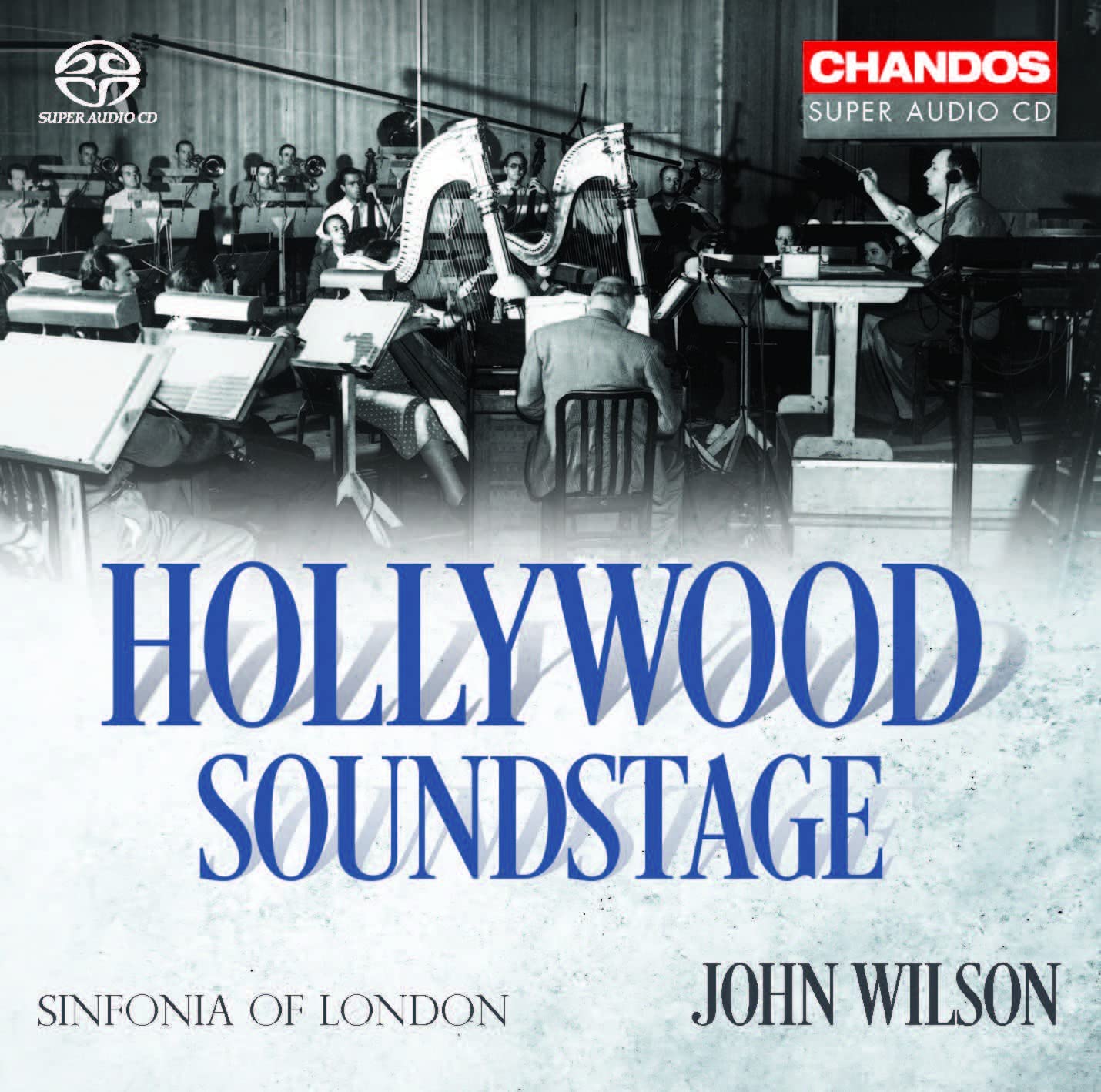
(Hollywood Soundstage, available on SACD from Chandos Records.)
Since 1994 the John Wilson Orchestra, with British conductor John Wilson at the helm, has become renowned throughout the world for their performances of music from the golden age of Hollywood and Broadway. In 2018, Wilson shifted focus and reestablished one of the most iconic orchestras in UK, the Sinfonia of London. The orchestra is best remembered for being on many great movie soundtracks, from “North by Northwest” to “The Snowman”. For this latest album, released in September on Chandos, John Wilson returns to the Golden Age of Hollywood.
The album begins with Erich Wolfgang Korngold’s stirring overture from “The Private Lives of Elizabeth and Essex” (1939). The piece consists of the typical Korngold fingerprints, such as regal and swashbuckling themes.
This is followed by David Raksin’s theme from “Laura” (1944), a piece which I think sounds ahead of its time. This recording features a superb trombone solo from Andy Wood and the piece consists of some wonderfully written variations on the main theme.
The next piece is the “Wizard of Oz” suite (1939), which consists of melodies from Harold Arlen’s songs as well as Herbert Stothart’s incidental music. It immediately transports you to those vibrant technicolour images in the MGM film directed by Victor Fleming, who also directed “Gone With The Wind”. The A-flat bicycle bell of Almira Gulch (a.k.a. the Wicked Witch of the West) makes an appearance.
Next is Frederick Loewe’s composition for both the stage (1956) and film (1964) versions of “My Fair Lady”. The film version of his “Transylvanian March” and “Embassy Waltz” is orchestrated by Alexander Courage, who is well known for writing the original Star Trek theme as well as orchestrating the film scores of composers like John Williams and Jerry Goldsmith.
Next is a suite from Max Steiner’s music to “Now, Voyager” (1942), which conductor John Wilson has arranged himself. I first heard performed live by the John Wilson Orchestra at the 2019 BBC Proms.
The next piece composed by Johnny Mandel is the main title from “The Sandpiper” (1965). Mandel is best remembered for composing the song “Suicide is Painless” (1970), the theme from “M*A*S*H”. The theme from the “Sandpiper”, also known as “The Shadow of Your Smile” features a brilliant trumpet solo perform by Mike Lovatt, former principal trumpet player of the John Wilson Orchestra.
Next is Franz Waxman’s suite from “Rebecca”, which was an Alfred Hitchcock film from 1940, his first American project. The score made use of two Novachords which was a form of early electronic instrument not dissimilar to a synthesiser. To recreate the sound on this track, Wilson uses modern keyboard instruments.
Finally, the street scene from “How to Marry a Millionaire” (1953) is Alfred Newman’s homage to Gershwin. I also think it also has traces of Charlie Chaplin’s score for “Modern Times” (1936), which Newman conducted and which David Raksin arranged with Edward Powell.
This SACD should be in the collections of all music lovers, even those are not keen on film scores. Also, I particularly like the brass playing on this album. The only criticism is… there should be more!
In this episode I speak to composer and conductor Timothy Brock. Who is renowned for numerous performances of his silent film scores and the music of Charlie Chaplin. The interview was recorded on July 1, 2022. In Bologna, Italy.
In this episode, I talk to American composer, conductor and orchestrator William Stromberg. Who is renowned for his re-recordings of classic film scores.
This episode was recorded via Zoom on 24/04/2022.
Title music from “The Man” (composed by Jerry Goldsmith), courtesy of Roger Feigelson.
For many film score junkies, the name Jerry Goldsmith brings
to mind a flood of memories and movie titles. He scored many great films such
as “Patton”, “Star Trek: The Motion Picture”, “The Sand Pebbles”, “Chinatown”
and “Total Recall” to name only a few. The vast majority of his work is
available on CD and online. But earlier this month new recordings of two scores
missing from his discography, were released by Intrada. His first theatrical
film score for George Montgomery’s western, “Black Patch” (1957) and his 1972
score for Joseph Sargent’s political drama “The Man”. Both scores have been
performed by The Royal Scottish National Orchestra under the baton of William
Stromberg and have been painstakingly reconstructed by Goldsmith expert Leigh
Phillips. The project itself was crowd funded through Kickstarter and I was one
of hundreds who pledged their support.
(Original "Black Patch" poster.)
The first score on the CD is “Black Patch”. The film was
made in 1957, directed by Allen H. Miner and was produced by its star, George
Montgomery. Despite being Goldsmiths first theatrical film score, the music is
pure Jerry Goldsmith!!! And it features earworms that you will never forget!!!
The first cue is the pre-credit music. It starts with a western style fanfare
played on horns before we have the whole orchestra playing in unison.
Later on in the score, the action cue that was composed for
a fight sequence is reminiscent of Goldsmith’s later scores, Such as “Total
Recall”. It is played at around 130 beats per minute and makes use of brass,
percussion, Piano and pizzicato strings. This will be of interest to many
people, like me, who are unfamiliar with Goldsmith’s early works.
Tracks 19 and 20 are two different versions of the end title
cue that features a tragic sounding love theme. Track 19 is an alternate
arrangement made by Leigh Phillips. Compared to the original (Track 20) it is
longer and has an ending that is less abrupt. I think that Goldsmith abruptly
ended the original, because he was writing the score in time to the picture and
the film came to an abrupt end.
(James Earl Jones as President Douglass Dilman, in this publicity still for "The Man".)
The second score on the CD is “The Man”. The 1972 film made
for ABC television, tells the fictional story of America’s first black
president, Douglass Dilman, who is played by James Earl Jones. Although it is
only a 15 minute score composed for a 90 minute film, it is still incredibly
moving and powerful. It opens with a brassy, Copland-esque fanfare, which plays
during the opening titles and throughout the score we hear variations on the
six note motif that we heard during that title sequence.
The Lincoln Memorial and Oval Office cues are probably the
most Copland-esque sounding pieces in the score. These are played when the
newly sworn in President Dilman pays a visit to the Lincoln Memorial and then
moves in to the Oval Office.
At the end of the film we hear a stirring rendition of “Hail
to the Chief”, arranged by Goldsmith which runs into the closing credit music.
To conclude this review, the CD is a must listen!!! At the
moment the album is not yet available to stream and I hope Intrada will make it
available on streaming platforms in the future. As I think it is important that
more people get to hear these rarities. I should also add that this album is my
first Intrada album. Intrada is a brilliant organisation based in
California, that specialises in movie soundtracks and many of their releases
are limited editions that are sourced from original elements. I would like to pay
tribute to Douglass Fake and Roger Feigelson, Who have toiled to make this album
a reality. As well as William Stromberg for conducting, Leigh Phillips for
reconstructing the scores and the musicians of The Royal Scottish National
Orchestra for their top-notch playing. I would also like to pay tribute to
Intrada’s shipping manager, Jeff Johnson, who has toiled to have the CDs sent
to the many backers and film score junkies that are out there. And finally I
simply cannot wait for Intrada’s next project and I shall start browsing their
website for more film music rarities.
On Saturday November 20th, I travelled to the renowned Glyndebourne Opera House in Sussex, to see (and hear) one of Charlie Chaplin‘s masterpieces, “City Lights“ (1931). The film was projected on a big screen and was accompanied by Chaplin’s own original score. The music was performed by the Glyndebourne Tour Orchestra under the baton of Jamie Phillips, who was making his debut at the Opera House.
Chaplin started making “City Lights” in the late 1920s following a somewhat rocky period when he made “The Circus”. In 1927 the world’s first talkie, “The Jazz Singer,” was premiered in New York and cinema changed forever. By 1930, silent films were seen as obsolete but Chaplin was determined that “City Lights” would follow on in the grand silent tradition.
Chaplin composed his own musical score with the assistance of arranger Arthur Johnston. Chaplin could not read or write music in the conventional way and needed a professional musician’s help with the details.
Amazingly, I have never seen “City Lights” in full until now. The music was played brilliantly and the orchestra exceeded my expectations by managing to replicate the 1930s playing styles, especially with a high level ofvibrato in the strings, which I believe is crucial when performing such a score.
The audience genuinely appreciated the film and it got plenty of laughs. The hospitality of the venue was top-notch. The surroundings were beautiful - it was my first time at Glyndebourne - and the atmosphere was great. After the film finished the orchestra gave a brief encore. Then, after the concert I fortuitously bumped into TV and film composer Paul Lewis and his wife, Sharon, and had a nice chat with them.
Me (Left) with Paul Lewis (Right).
All in all, I had a splendid day, and had several firsts: first time at Glyndebourne, first entire viewing of “City Lights” on the big screen, and a first for hearing The Glyndebourne Tour Orchestra. I can only hope now, that Glyndebourne does even more of these screenings in the future.
In this episode, I speak to broadcaster and film music expert Tommy Pearson. This episode was recorded 16th November 2021, via Zoom. Apologies for any issues with the sound quality.
In this edition, I talk to conductor Ben Palmer about working in film. This episode was recorded in Berlin, October 24th 2021, prior to a screening of Charlie Chaplin’s “The Kid” (1921) at the Babylon cinema.
In this episode I speak to composer, conductor and silent film accompanist Günter A. Buchwald. It was recorded on Friday October 8th, 2021. At the Le Giornate Del Cinema Muto Festival in Pordenone, Italy.
In this first edition of the Film Score Junkie podcast, I talk to composer, writer, broadcaster and film music expert Neil Brand. This episode was recorded over two days (October 6th and 7th) at the 2021 Le Giornate Del Cinema Muto Festival in Pordenone, Italy.
Last Saturday I had the opportunity to meet one of my idols, the conductor, John Wilson. I attended the BBC Proms at the Royal Albert Hall, in London. John Wilson and his new orchestra, the Sinfonia of London, were performing works by mainly Austrian composers. The highlight of the concert for me, was the “Symphony in F sharp” by Erich Wolfgang Korngold, who was from the Viennese School of Composers, and studied under Richard Strauss and Alexander von Zemlinsky. He made a name for himself scoring many golden-age Hollywood films, such as “Captain Blood” (1935) and “The Adventures of Robin Hood” (1938) both starring Errol Flynn.
John Wilson.
The first half opened with the overture from “Der Fledermaus” by Johann Strauss II. Like a lot of well known compositions, you may know what it sounds like, but not what it’s called. That was the case with me. I knew it as the music that accompanied “Tom and Jerry at the Hollywood Bowl” and crashing cars during the opening of Disney’s “The Love Bug“. The operetta the overture was written for, was based on a play entitled “the prison“ by Roderich Benedix.
Strauss’s overture was followed by “Seven Early Songs“ by Alban Berg, and sung wonderfully by soprano Francesca Chiejina. The songs were originally written over three years from 1905 to 1908, but were not orchestrated by the composer until 1928.
Francesca Chiejina.
This was followed by Ravel’s “La Valse”, a piece described as a tribute to the Viennese waltz. At first I thought it was Strauss, but the seemingly chaotic tones and rhythms at the end are said to reflect the descent of Vienna after the Great War.
The Korngold “Symphony in F Sharp” is a piece I have never heard in full. The symphony began with a quiet and mysterious passage, played on percussion with pizzicato strings and piano. Then, as the peace progressed, it started to sound more cinematic. At various points I was reminded of the scores from “Jaws” and “Indiana Jones”. It seems to me (and has also been commented on by others) that John Williams was influenced by Korngold. It’s my loss, but the only pieces of Korngold that I am familiar with are his “Theme and Variations” and, of course, his film scores.
The concert wound up with a piece by Korngold’s teacher, Zemlinsky, as the deserved encore, a piece that predates film scores but sounded, for all the world, just like one.
I, myself, am passionate about film music, and this is how I became familiar with John Wilson’s work, as he is often associated with music from the stage and screen. In fact I attended this particular Prom because I am familiar with film music history and how it has its roots in the music played at this concert. I imagine that John Wilson chose these pieces because he wanted to show what preceded Hollywood film scoring, to enable the audience to understand the evolution of golden-age film music.
John Wilson (with mask on) after the concert.
Autographs from John Wilson (large signature on right) and members of the Sinfonia of London.
I very much enjoyed the concert and felt so lucky to be able to have a short discussion with John as he left the Albert Hall. His parting words to me were, “Study the music you enjoy!” Wise words indeed.
When I set up this blog, I originally wanted to talk about film music and film music only. However I have decided to make an exception to that rule (sort of). Last Friday, I went to the Edinburgh International Festival to see a performance of a revue celebrating the musicals of Rogers and Hammerstein, entitled A Grand Night for Singing. It was written by Walter Bobbie and was first performed on Broadway in 1993. This semi-staged and slightly updated version of the show was conceived by American singer and actress Kim Criswell. Those who are familiar with the John Wilson Orchestra, may be reminded of Kim’s wonderful interpretations of Judy Garland classics such as, “The Trolley Song”, “Over The Rainbow” and “Get Happy”. The music was directed by British pianist, conductor and organist Wayne Marshall OBE, Kim’s long-term collaborator. The cast consisted of Kim Criswell, Danielle de Niese, Damian Humbley and fellow John Wilson veterans Anna-Jane Casey and Richard Morrison.
When the show began, Andrew Moore, the festival’s director of music made an announcement. He told us that Danielle de Niese had gone down with laryngitis and was unable to sing... I feared the whole event would need to be cancelled and that I may have travelled to Edinburgh in vain... But, that Jessica Leary would stand in for her singing parts! Phew! This worked so seamlessly, I forgot that Jessica was on the side of the stage, unless I looked at her directly. Because of this I have not had the pleasure of hearing Danielle sing, but it was a real pleasure to hear Jessica sing the part and watch Danielle act it.
(Jessica Leary)
The show got underway with a medley that consisted of the waltz from “Carousel“ and “So Far“ from Allegro before the cast finished their medley with the song that the show was named after, “It’s a Grand Night for Singing” from State Fair. The band, led by Wayne Marshall, provided a superb and whimsical accompaniment. Kim Criswell treated us to a lively rendition of “I Can’t Say No“ from Oklahoma!. To continue with the Oklahoma! theme, Richard Morrison opened the second act giving us a rather energised arrangement of “Oh, What a Beautiful Mornin’”. Anna-Jane Casey treated us to spectacular dancing as well as singing when she performed “It’s me” from Me and Juliet.
Other songs featured included “It Might As Well Be Spring” from State Fair, “Love, Look Away” (Flower Drum Song), “A Lovely Night” (Cinderella) and “This Nearly Was Mine” (South Pacific). They closed with “I Have Dreamed” from The King and I. Some of these songs I knew, but others I was hearing for the first time.
After the show had ended I waited outside the stage door, despite the unseasonably cold weather. Wayne Marshall, the musical director was the first to come out, probably because he had less make-up to remove, and no costume to change, but he was shortly followed by the singers. I was lucky enough to both meet and chat to them, and they were kind enough to spend some time with me.
(Me with Wayne Marshall.)
(Me with Richard Morrison.)
(Me with Damian Humbley.)
(Me with Anna-Jane Casey.)
(Me with Danielle de Niese.)
(Me with Kim Criswell.)
So all in all, this was a lively revue-style show featuring a variety of songs from some of Rodgers and Hammerstein’s better and lesser known musicals, sung by some of the best performers around. There is something in it for every lover of musical theatre, whether you are familiar with all the works or not. As this was put together for the main Edinburgh Festival, you might not have an opportunity to see this in the near future, but if it should it later tour, or reappear at a later date, I would warmly recommend that you try to see it.
50 years ago, on June 30th, 1971, the movie musical “Willy Wonka and the Chocolate Factory” was released. This is a movie that I have grown up with and I have never got bored with watching it or listening to the music.
The film was based on the book by
Roald Dahl called “Charlie and the chocolate factory”. It was directed by Mel
Stuart based on the screen play by Roald Dahl. Stuart had been introduced to
the book by his daughter. David Seltzer was brought in to adapt Dahl’s screen
play and bolster it with more drama and music. It has been said that Dahl did
not like the result because it did not stick to his original story. However,
Dahl did spend a lot of time on set during the filming, so it is not clear how
true his criticism of Seltzer’s adaptations was. Dahl did initially suggest
Spike Milligan as Willy Wonka because it fitted the image inside his head, but,
as we all know Gene Wilder fitted the role fantastically. The name of the film
differs from the book because it was actually made to promote a new product by Quaker
Oats. The company sponsored a lot of Wolper’s TV programmes and planned to make
and sell Wonka Bars, hence Willy Wonka and the Chocolate Factory. However, this
backfired because the Wonka bars had a flaw that cause them to melt on the
sweet shop shelves. They were a flop! Surprisingly, the film also flopped at
the box office, but since then it has been shown over and over on TV and has
built up a massive fan-base.
During pre-production Stuart and
Wolper decided that the film should be a musical. Wolper drafted in his friends,
the songwriters Anthony Newly and Leslie Bricusse. Newly and Bricusse had
worked together before on numerous projects, such as the title song from
Goldfinger with music by John Barry and sung by Shirley Bassey. Walter Scharf
was enlisted to arrange and orchestrate the music the film - bringing together
the songs and creating pieces (e.g., incidental music) that resulted in a
holistic score. Scharf had previously worked with both Wolper and Stuart on
documentaries and films, such as The Undersea World of Jacques Cousteau, If
It’s Tuesday This Must Be Belgium and numerous TV programmes for the National
Geographic Society, but he had fallen out with Stuart and was reluctant to fly
out to Munich to join the rest of the cast. However, he did decide to go and
was impressed by the Munich-based orchestra that had been employed to work with
him.
(Anthony Newly and Leslie Bricusse)
(Walter Scharf)
The opening titles of the film roll
with the Overture which consists of two songs, Golden Ticket and Pure Imagination.
This is one of my favourite parts of the score, because of its orchestration
and the huge sound that it makes. This gives the impression that it is a big
budget film, even though it wasn’t. The music creates a sense of anticipation
at the wonderful story that is about to unfold, whilst the titles consist of a
montage of chocolate making which ramps-up the excitement. The footage for this
sequence was shot at the Toblerone factory in Switzerland.
(Overture, arranged by Scharf)
(Walter Scharf's arrangement of "The Candy Man" song)
Almost immediately after the opening titles we hear The Candy Man song, sung by veteran British stage performer Aubrey Woods, although it would be Sammy Davis Jr who would later make the song famous. Woods played Bill the sweet shop owner, who doesn’t seem interested in making any money because he’s just giving all his candy away during the number! The scene shows how important candies are to kids; confectioners like Wonka and Slugworth are like gods in their eyes. But, as the upbeat song tails off, Charlie Bucket is shown outside the shop looking in. He has the same desires as the other kids but is unable to access the wonderful treats on offer because he is poor. Here begins the story of the divide between the haves and the have not's.
The next song accentuates this
trope as it stands in binary opposition to The Candy Man. Cheer up, Charlie is
a downbeat ballad sung by Charlie’s mother after Charlie expresses his upset at
the unfairness of life after Wonka announces a competition to find 5 golden
tickets hidden in Wonka bars; the poverty of the Bucket family means he has virtually
no chance of finding a ticket as he can’t afford to buy the chocolate.
But Charlie finds a coin and is
able to buy another Wonka bar. At this point we hear a reprise of The Candy Man
music as he finds himself outside the sweet shop. As he leaves the shop we see
a commotion around the newsstand and a crowd gathering; ticket number five was a
fake! Charlie takes the unopened bar of chocolate from his pocket…..and we hear
a harp, tremoring strings, and, with a glint of gold, we hear a piccolo. Throughout
the film repetition of pieces of incidental music provide cues to the audience
for similar situations. Magical moments are often preceded by bells, chimes and
harps, accentuating the wondrousness about to happen.
Finding the golden ticket is
heralded by a trumpeting of I’ve Got a Golden Ticket and this plays out in an upbeat
and dramatic style as he runs home. This piece harks back to the overture, but
also provides us with a hint of the song Grandpa and Charlie are about to sing.
Suddenly, however, the music stops abruptly as the baddie, Slugworth, enters
the scene and the music switches to Slugworth’s leitmotif, which differs with
the child, but is always sinister in nature. Slugworth explains to Charlie that
he will make him rich, so he can buy “A new house for your family, and good
food and comfort for the rest of their lives”, but only if he steals an
everlasting gobstopper from Wonka. When Charlie arrives home at his tiny shack,
he reveals to his family that he has found the last ticket and wants Grandpa Joe
to go with him to the factory. The Golden Ticket duet song plays, with scenes
of slapstick and the mimicking of top hat and tails with his regular hat and
walking stick.
On the day of the factory visit, as
all the children gather outside the gates, the brass band plays what resembles
the Old Comrades March. It gives the feeling of a grand occasion, with all the pomp
and ceremony we come to expect with important and official events. This gives
the feeling that Wonka is seen as a very important man and the children are
very privileged to be allowed into his secretive world. As the guests enter The
Chocolate Room we hear the harp play as the door opens and it is revealed to the
audience. During the song Pure Imagination we hear ticking chimes, which seem
to signal the passing of time as if Wonka knows his time is running out to find
a child that he feels can be trusted and who is worthy of taking over his
factory. Later in the factory visit, Charlie and Grandpa Joe steal fizzy
lifting drink and float around, swimming in the bubbles. The music reminds me
of Scharf’s scores for Jacques Cousteau. I wonder if this this was written
solely by Scharf, rather than being an adaptation of Newley and Bricusse’s
music.
Apart from Charlie, Verruca Salt
is the only child with her own song. Just before she starts to sing, she demands
her father buy her a golden goose. When she is told by Wonka “They’re not for
sale” she kicks-off because Verruca is not used to being refused; she is a
total brat! During filming the actress, Julie Dawn Cole, was asked over and
over by Mel Stuart to be “nastier!”, and “even nastier!” Her song - I Want It Now
– is reminiscent of My Favourite Things from The Sound of Music....but nastier!
The Oopalumpa’s songs provide a link between all the children except Charlie.
These songs are sung after each child has broken the rules and the Oompalumpa’s
are asked by Wonka to deal the problem. The doleful rhymes tell of how the
naughty, greedy, and brattish behaviour of children leads to their downfall.
The original ending of the
screenplay had Wonka shouting “Yippee” when Charlie returned the everlasting
gobstopper and agrees to take over the factory. However, Stuart felt this was a
lame line and refused to end the film with his main character shouting “Yippee!”
He tracked down Seltzer, who had gone on vacation, to come up with a better
ending. Thinking on his feet, Seltzer came up with the wonderful line,
“Charlie, don’t forget what happened to the man who suddenly got everything he
wanted. He lived happily ever after.” And, with that line, the music of Pure
Imagination swelled, the choir joined in telling us that if we wanted to view
Paradise all we had to do was look around us and we are convinced that the
world would really a better place if we could only see it as Willy and Charlie
do.
Every time I watch this film my
understanding of the contribution the music made to the narrative grows. Even
for a small child, the music, whether it be the songs of Newly and Bricusse, or
the orchestral colours of Scharf, works to create a sensation of wonder, hope
and confectionary. And those are three things I hope never to tire of.
Thank you to John Altman, who has provided me with some interesting anecdotes about Walter Scharf.
10 minute extract from 4K restoration of Willy Wonka: https://www.youtube.com/watch?v=72vLikHT5OE