Showing posts with label John Wilson. Show all posts

Sunday, 19 November 2023

Review: John Wilson and his Sinfonia of London at Bridgewater Hall, Manchester (15/11/2023).


Once again, legendary British conductor John Wilson has been on tour presenting some of the greatest hits of Hollywood, with renowned singers Kim Criswell, Matt Ford and Jamie Parker. The orchestra was Wilson’s own Sinfonia of London re-established by him in 2018.


The concert at Manchester’s Bridgewater Hall, opened with the MGM Jubilee Overture which was arranged in 1954 by the studio’s musical director, Johnny Green. This instrumental medley features numerous MGM numbers such as Singin’ in the RainI’ve Got You Under My SkinOver the Rainbow and The Trolley Song. Having heard the original recording of it as well as John Wilson's recording, Wilson conducted a little bit faster in places on this occasion. In my opinion this does not ruin the piece. On the contrary I think it helps to drive it along and works remarkably well in concert.


Kim Criswell and Matt Ford flawlessly delivered Cole Porter’s Stereophonic Sound from 1957’s Silk Stockings. Having recently sung this song with a friend at Dartington summer school, back in August, I can confirm that it is not the easiest song to perform. Matt Ford then left the stage and Kim Criswell then gave us a haunting and very emotional solo performance of Secret Love, that was originally performed by Doris Day in Calamity JaneThe Heather on the Hill from Brigadoon is a great example, not only of fine music and lyrics going together, but also of great arranging. The song was written for the film by Lerner and Lowe and was arranged by Conrad Salinger. Actor and singer, Jamie Parker performed the vocal refrain. His performance was nice and gentle, this contrasted with the ballet music that Salinger had arranged.


Another instrumental piece, was the overture from High Society, arranged from Cole Porter’s songs for the film by Conrad Salinger and Lloyd ‘Skip’ Martin. John Wilson conducted lightly and with finesse and the orchestra gave the music the articulation and colour that it needed. For me the highlight of the first half, was Matt Ford's performance of Pure Imagination, from Willy Wonka and the Chocolate Factory, in its original arrangement by Walter Scharf. As a fan of the film and its music I was paying particular attention to this performance, and I think it was electrifying.


Kim Criswell concluded the first half with I Got Rhythm from Girl Crazy. During the instrumental part, the audience applauded different sections of the orchestra as if they were jazz players, even the violins and violas, who stood up and gave us a spine-tingling virtuoso performance.


The second half began with the main title music from Singin’ in the Rain, this involved all three vocalists, who sang the first verse of the title song whilst walking across the stage. It was immediately followed by Good Morning. Both pieces were perfect representatives of such a film.


One rarity that was played, was the Jerry Herman ballad Love is Only Love written for the film version of Hello Dolly! and was originally performed by the star of the film, Barbra Streisand. Kim Criswell has an extraordinary ability to channel the great leading ladies of Hollywood and Broadway, including Streisand. Another glorious rarity was the original Irwin Kostal arrangement of Jolly Holiday from Mary Poppins, complete with members of the orchestra playing kazoos during the Penguin dance sequence.


Matt Ford gave a wonderful and moving performance of If ever I would leave you from Camelot and I think John Wilson was right to call it one of Frederick Lowe’s finest ballads. Jamie Parker’s rendition of I’ve Grown Accustomed to Her Face from My Fair Lady, may not have been an imitation of Rex Harrison, but he certainly was able to channel him. Learning all those words for such dramatic number must have been a huge challenge.


The penultimate piece of the evening was the unofficial Hollywood anthem That's Entertainment from 1953’s The Band Wagon. I could not help mouthing along to this number, knowing every word of it. The encore which brought the evening and the tour to an end was There's No Business Like Show Business, originally from Annie Get Your Gun. I am unfamiliar with the arrangement that was performed. But Kim, Matt and Jamie did splendidly with Kim taking the lead with here spot on Ethel Merman imitation.


I believe that this was a glorious performance as well as a wonderful end to a national tour. I sincerely hope that John Wilson and the team embark on another one next year. Also, I wonder if there’s any chance in the future of such a show returning to the proms.

Thursday, 12 January 2023

Review: Kim Criswell, John Wilson and The Royal Stockholm Philharmonic


Last Thursday, whilst on a trip to Stockholm, I attended a concert of film music performed by Broadway singer Kim Criswell and The Royal Stockholm Philharmonic. It was conducted by the champion of film and theatre music, John Wilson. 


The concert opened with Erich Wolfgang Korngold’s title music from ‘King’s Row’. John Wilson paraphrased Andre Previn saying that people have often said that Korngold sounds like Hollywood, but in fact it was the reverse, Hollywood sounded like Korngold. The main title music from the film provided us a stirring fanfare somewhat reminiscent of what John Williams would later write for Star Wars. This is no coincidence, as it was what George Lucas wanted for his films. It was a very energizing opening. This was followed by Bronislaw Kaper’s overture to ‘Mutiny on the Bounty’. This music is somewhat of a rarity when it comes to live performances, and it is a score that I am not familiar. ‘Mutiny on the Bounty’ was written in the 1960s, but it sounds like one of those swashbuckling tunes of the 1930s from films like ‘Captain Blood’ and ‘The Sea Hawk’. To me, it sounded very Golden Age.


The theme of movie musicals began with George Gershwin’s overture from the film ‘Strike Up the Band’, which was a Metro-Goldwyn-Mayer film, produced by the Freed Unit. This is the same group that gave us musicals like ‘Singin’ in the Rain’ and ‘The Band Wagon’. After that, Kim Criswell came on stage to sing her first song of the evening, ‘I Get A Kick Out of You’, written by Cole Porter. Then came the ‘Wizard of Oz’ suite; a compilation of songs by Harold Arlen with the incidental music by Herbert Stothart. John Wilson has recently recorded this for his Hollywood Soundstage album with the Sinfonia of London for Chandos, which I reviewed in October. We then had a couple of love songs from Kim, one by the Gershwin Brothers called ‘Love Walked In’ from the film called ‘Goldwyn Follies’ and then a song called ‘Love’ that was originally sung by Lena Horne in the film “Ziegfeld Follies’. In comparison to ‘Love Walked in’, ‘Love’ is a slightly naughty, sexy song, and Kim really captured this mood. The song was composed by Hugh Martin with lyrics by Ralph Blane. Just before the interval, we had the ‘Ride of the Cossacks’ by Franz Waxman from the film ‘Taras Bulba’. This is a rhythmic piece, mimicking galloping horses. It makes use of instruments like Wagner tubers, which give it a unique sound.  


After the interval, we had the overture from the film ‘My Fair Lady’. Again, this was a wonderful opening piece. The music was by Frederick Loewe and the arranger was Alexander Courage, who is best remembered for composing the theme to the original Star Trek series. The film ‘My Fair Lady’ won Andre Previn an Oscar for musical direction. We then had the suite from ‘Casablanca’ composed by Max Steiner. A completion of highlights from the film score, which included the famous piano solo, ‘As Time Goes By’, which isn’t by Steiner, but by Herman Hupfeld. We then had the overture from the movie ‘The Sound of Music’. The score was arranged by Irwin Kostal, who, at the time, had just worked with Julie Andrews on ‘Mary Poppins’. This overture is typical of Kostal, with horns, low woodwinds and heavy on percussion. Following the overture, the orchestra segued into the song, ‘I Have Confidence’, which was written specifically for the film version of ‘The Sound of Music’ by Richard Rodgers. He is credited with writing both music and lyrics, but it is said that that this song was ghost-written by Saul Chaplin, though Richard Rogers got the credit for it. Even so, it sounds very ‘Richard Rogers’. Kim did a ‘spot-on’ Julie Andrews-style performance. She is excellent at channelling famous singers and gave me a wonderful sample of her talent when I interviewed her for my podcast. ‘I Have Confidence’ is set at a point in the film when Maria is leaving the nunnery and going to work as a governess for Captain Von Trapp and his children. At first, she's frightened and nervous but tries to shake it off and pretends to have confidence, and as she sings she gets cockier, and the music matches her mood. The rhythm gets faster until eventually, at the climax of the song, we get trumpets blasting in a vaudevillian style. This is typical of Irwin Kostal arranging-style and is probably why he got the ‘Mary Poppins’ gig; his old vaudevillian sound also fits well with Julie Andrews because she was from an English music hall background. Irwin Kostal got an Oscar for music direction for ‘The Sound of Music’. 


Next, were the Barbra Streisand songs, which was something I was looking forward. The song ‘People’ from the movie ‘Funny Girl’ was arranged by Walter Scharf. I had heard his arrangements before, but I was really looking forward to hearing one in concert because he has a very atmospheric way of arranging. Kim really channelled her inner-Barbara Streisand for this song. Barbra Streisand and Julie Andrews, as well as Judy Garland, are some of Kim’s childhood heroes. If you want to know more about this, listen to my podcast with her. I really love Scharf’s arrangement for the film ‘Funny Girl’, but I’ve read that Jule Styne, the composer, actually didn't like his arrangement because he thought they were too pop orientated. But I completely disagree! I've listened to the original cast album, and compared it with the film version, and I think some of those film arrangements are much better. Scharf did a wonderful job at expanding, not just the orchestra size, but also adding additional textures and re-harmonizing and reworking parts and adding in quality that the stage version lacks.  


Next was John Williams, who is probably one of the greatest living composers. ‘Close Encounters of the Third Kind’ was directed by Steven Spielberg and, as John Wilson said at the performance, it is one of John Williams most ‘unique’ scores because it is avant-garde in places and involves a wide range of orchestral techniques. The highlight of the piece was the famous five-note motif, which the entire score pretty much derives from. I only wish that John Wilson could have performed some of the ‘Conversations’ music, which is perhaps some of the greatest music Williams has ever written. It is said that he composed it to 12 minutes of blank film!


Moving back to Barbra Streisand, the concert concluded with two numbers from Yentl, with music by Michel Legrand and lyrics by Alan and Marilyn Bergman. Yentl was a film that Barbra Streisand not only starred in, but also directed and produced. The story is set in a traditional Jewish community in Eastern Europe. It is about a young Jewish girl called Yentl who wants to study so she disguises herself as a boy in order to fulfil her dream. ‘The way he makes me feel’ is about when Yentl falls in love with a young man at school. The final song ‘A Piece of Sky’ was the perfect ending to a concert. It was perfect in the sense that not only did it sound perfect, but, if you think of the chronology of movie musicals, Yentl was the most recent. I think the final two songs were probably the two best pieces of the evening. Legrand is one of those composers who is a great songwriter and arranger, a well as being a famous jazz pianist. He is probably best known for scoring films like ‘Ice Station Zebra’ ‘Summer of '42’ and ‘Never Say Never Again’. Yentil was released in 1983 and it won Legrand and the Bergman’s Oscars for their work. 


I have seen both John Wilson and Kim Criswell perform live before, but never together. So, it was a wonderful experience to see them collaborating on film music, supported by such a fine orchestra.

Monday, 10 October 2022

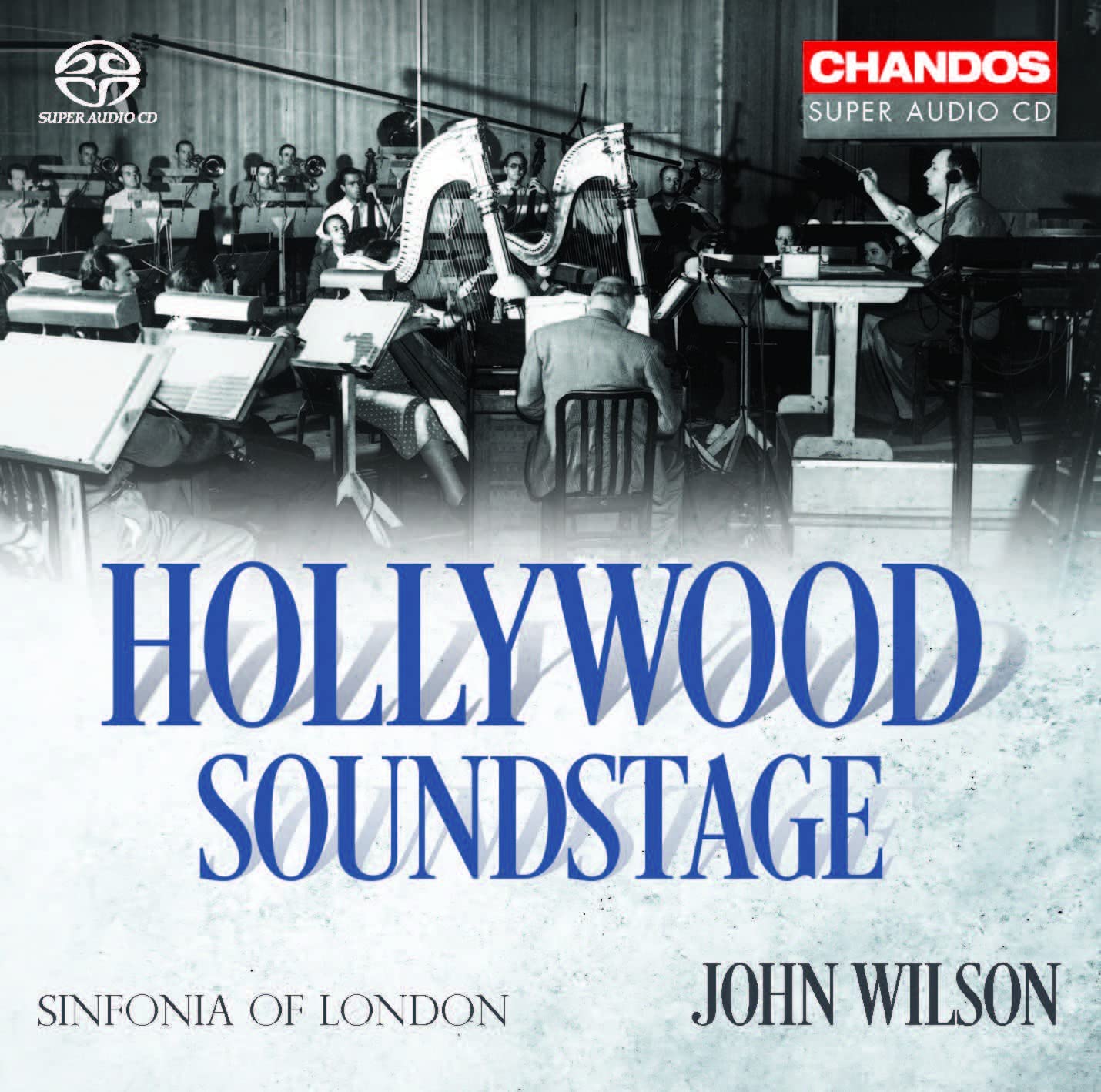
Review: "Hollywood Soundstage"; John Wilson and the Sinfonia of London.

(Hollywood Soundstage, available on SACD from Chandos Records.)

Since 1994 the John Wilson Orchestra, with British conductor John Wilson at the helm, has become renowned throughout the world for their performances of music from the golden age of Hollywood and Broadway. In 2018, Wilson shifted focus and reestablished one of the most iconic orchestras in UK, the Sinfonia of London. The orchestra is best remembered for being on many great movie soundtracks, from “North by Northwest” to “The Snowman”. For this latest album, released in September on Chandos, John Wilson returns to the Golden Age of Hollywood.

The album begins with Erich Wolfgang Korngold’s stirring overture from “The Private Lives of Elizabeth and Essex” (1939). The piece consists of the typical Korngold fingerprints, such as regal and swashbuckling themes.

This is followed by David Raksin’s theme from “Laura” (1944), a piece which I think sounds ahead of its time. This recording features a superb trombone solo from Andy Wood and the piece consists of some wonderfully written variations on the main theme.

The next piece is the “Wizard of Oz” suite (1939), which consists of melodies from Harold Arlen’s songs as well as Herbert Stothart’s incidental music. It immediately transports you to those vibrant technicolour images in the MGM film directed by Victor Fleming, who also directed “Gone With The Wind”. The A-flat bicycle bell of Almira Gulch (a.k.a. the Wicked Witch of the West) makes an appearance.

Next is Frederick Loewe’s composition for both the stage (1956) and film (1964) versions of “My Fair Lady”. The film version of his “Transylvanian March” and “Embassy Waltz” is orchestrated by Alexander Courage, who is well known for writing the original Star Trek theme as well as orchestrating the film scores of composers like John Williams and Jerry Goldsmith.

Next is a suite from Max Steiner’s music to “Now, Voyager” (1942), which conductor John Wilson has arranged himself. I first heard performed live by the John Wilson Orchestra at the 2019 BBC Proms.

The next piece composed by Johnny Mandel is the main title from “The Sandpiper” (1965). Mandel is best remembered for composing the song “Suicide is Painless” (1970), the theme from “M*A*S*H”. The theme from the “Sandpiper”, also known as “The Shadow of Your Smile” features a brilliant trumpet solo perform by Mike Lovatt, former principal trumpet player of the John Wilson Orchestra.

Next is Franz Waxman’s suite from “Rebecca”, which was an Alfred Hitchcock film from 1940, his first American project. The score made use of two Novachords which was a form of early electronic instrument not dissimilar to a synthesiser. To recreate the sound on this track, Wilson uses modern keyboard instruments.

Finally, the street scene from “How to Marry a Millionaire” (1953) is Alfred Newman’s homage to Gershwin. I also think it also has traces of Charlie Chaplin’s score for “Modern Times” (1936), which Newman conducted and which David Raksin arranged with Edward Powell.

This SACD should be in the collections of all music lovers, even those are not keen on film scores. Also, I particularly like the brass playing on this album. The only criticism is… there should be more!

Acknowledgements…

Presto Music Classical Podcast: https://www.prestomusic.com/classical/articles/4858--presto-music-classical-podcast-episode-30-music-from-the-golden-age-of-hollywood-with-john-wilson
Chandos Records: https://www.chandos.net/products/catalogue/CHAN%205294
Sinfonia of London: https://sinfoniaoflondon.com
John Wilson: https://johnwilsonconductor.com

Thursday, 9 September 2021

BBC Proms 2021: John Wilson and the Sinfonia of London.

Last Saturday I had the opportunity to meet one of my idols, the conductor, John Wilson. I attended the BBC Proms at the Royal Albert Hall, in London. John Wilson and his new orchestra, the Sinfonia of London, were performing works by mainly Austrian composers. The highlight of the concert for me, was the “Symphony in F sharp” by Erich Wolfgang Korngold, who was from the Viennese School of Composers, and studied under Richard Strauss and Alexander von Zemlinsky. He made a name for himself scoring many golden-age Hollywood films, such as “Captain Blood” (1935) and “The Adventures of Robin Hood” (1938) both starring Errol Flynn.

John Wilson.

The first half opened with the overture from “Der Fledermaus” by Johann Strauss II. Like a lot of well known compositions, you may know what it sounds like, but not what it’s called. That was the case with me. I knew it as the music that accompanied “Tom and Jerry at the Hollywood Bowl” and crashing cars during the opening of Disney’s “The Love Bug“. The operetta the overture was written for, was based on a play entitled “the prison“ by Roderich Benedix.

Strauss’s overture was followed by “Seven Early Songs“ by Alban Berg, and sung wonderfully by soprano Francesca Chiejina. The songs were originally written over three years from 1905 to 1908, but were not orchestrated by the composer until 1928.

Francesca Chiejina.

This was followed by Ravel’s “La Valse”, a piece described as a tribute to the Viennese waltz. At first I thought it was Strauss, but the seemingly chaotic tones and rhythms at the end are said to reflect the descent of Vienna after the Great War.

The Korngold “Symphony in F Sharp” is a piece I have never heard in full. The symphony began with a quiet and mysterious passage, played on percussion with pizzicato strings and piano. Then, as the peace progressed, it started to sound more cinematic. At various points I was reminded of the scores from “Jaws” and “Indiana Jones”. It seems to me (and has also been commented on by others) that John Williams was influenced by Korngold. It’s my loss, but the only pieces of Korngold that I am familiar with are his “Theme and Variations” and, of course, his film scores.

The concert wound up with a piece by Korngold’s teacher, Zemlinsky, as the deserved encore, a piece that predates film scores but sounded, for all the world, just like one.

I, myself, am passionate about film music, and this is how I became familiar with John Wilson’s work, as he is often associated with music from the stage and screen. In fact I attended this particular Prom because I am familiar with film music history and how it has its roots in the music played at this concert. I imagine that John Wilson chose these pieces because he wanted to show what preceded Hollywood film scoring, to enable the audience to understand the evolution of golden-age film music.

John Wilson (with mask on) after the concert.

Autographs from John Wilson (large signature on right) and members of the Sinfonia of London.


I very much enjoyed the concert and felt so lucky to be able to have a short discussion with John as he left the Albert Hall. His parting words to me were, “Study the music you enjoy!” Wise words indeed.

Watch the full concert on BBC iPlayer: https://bbc.in/3tGu6MF
Listen on BBC Sounds: https://bbc.in/3nhkwOO

Scoring the Past: Timothy Brock at Il Cinema Ritrovato 2026

(Composer/Conductor Timothy Brock) I recently attended the 40th Il Cinema Ritrovato Film Festival in Bologna and picked up some fascinating ...